
In 1990, the Nobel prize-winning economist Amartya Sen examined population data from the 1990 world census to determine if countries with historic traditions of female infanticide and severe sex discrimination had normal sex ratios. The degree of sex ratio distortion, and hence the number of females “missing” from the populations in these countries, exceeded even what Sen was prepared to find. He calculated that at least 100 million women and girls were demographically “missing” (dead) from the world as of 1990. That was 3.7% of the world’s female population at the time — eliminated. Sen’s pathbreaking study appeared in the New York Review of Books that year.12
Academic demographers continued Sen’s research, measuring the number of “missing” women each decade after a new world census. The number climbed upward with time. In 2020, after the most recent world census, they calculated that 143 million women are now “missing.” The United Nations Population Fund published these findings in its State of the World Population 2020 report.13 In percentage terms, 3.7 percent of the global female population is still missing, meaning that the number of missing women is growing at the same rate as the female population itself.
The number of missing women is expected to grow to 150 million by 2035 before starting to slowly decline.14
Each year, 3.2 million women disappear from the population due to the causes listed above. The annual loss of females breaks down like this:15
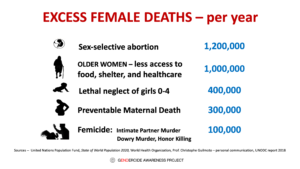
Feminicide is the killing of women for cultural reasons where there is no equivalent reason for killing men. Feminicide includes intimate partner murder, dowry murder, honor killing, and the killing of women associated with rival groups (gangs, tribes) as a strike against the group’s men. The total loss of female life due to feminicide is just under 100,000 per year.12c The asymmetry of feminicide leads advocates to define it, somewhat confusingly, as “killing a woman because she is a woman.” While women do occasionally kill their male partners, they generally do not do so as the culmination of behaviors intended to intimidate and control.

Leave A Comment