
Gendercide Awareness Video
Did You Know?
- Demographers now estimate that 143 million women are missing due to female gendercide (also called femicide).
- That’s more deaths than WWI and WWII combined.
- Every year, we lose 3.2 million women and girls to gendercide. That’s six per minute.
- In China alone, 72 million women are missing. That amounts to 10.3% of its female population. India is missing 9.3% of its female population.
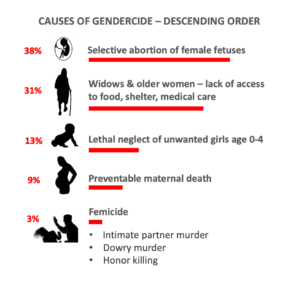
Sources — United Nations Population Fund, State of World Population (SWOP) 2020
World Health Organization, UNODC report 2018,
Prof. Christophe Guilmoto, SWOP 2020 author (Personal communication)
The terms female genocide, female gendercide, or just “gendercide,” all refer to the worldwide elimination of women and girls that is directly attributable to oppression and lack of rights — to inequality between the sexes. Gendercide measures excess female deaths relative to male deaths — for men and women of the same age living in the same country. In other words, gendercide measures female deaths beyond what is expected and normal.
The two largest causes are
- the selective abortion of female fetuses in countries where sons are strongly preferred over daughters
- the inability of older women to access food, shelter, and medical care as successfully as men.
Additional causes include lethal neglect of unwanted girls, preventable maternal death, and femicide (intimate partner murder, dowry murder, honor killing).
Most gendercide passes under the radar. For very young females, it occurs within the privacy of the family against an almost voiceless victim. This is the case with sex-selective abortion and the neglect of unwanted girls, which together account for 50% of the annual loss of females.
The other 50% occurs among adult women — much of it resulting from customs, laws, and economic barriers that force women into dependency and redirect their wealth to male relatives. For example, in much of the world, women farm the land that their husbands own. They cannot access the wealth that generates, nor can they acquire the land upon the death of their husbands. It goes to the male next of kin. In other places, women are permitted to inherit, but their inheritances are given to their husbands and male in-laws. The result is that wealth is concentrated in the hands of men, and that some older women, especially widows, become so poor they simply do not survive.
Femicide is the violent and intentional murder of a woman in a context that rarely applies to a man — for example, intimate partner murder, dowry murder, honor killing. It is the part of gendercide we see in the news, but it accounts for just 3% of the annual loss of women. It is the visible part of the gendercide ice berg, pointing to a much larger loss of females that is submerged and invisible.
Each year we lose 3.2 million girls and women to gendercide. Roughly half are girls, and half are women.1
The cumulative loss over time is 143 million demographically “missing” women and girls.2. 143 million is only the part of that loss — the part that demographers can measure. The actual loss is much greater.
Before birth
During the period 1980 – 2000, sex-selective abortion displaced infanticide as the primary way of eliminating unwanted baby girls.3
Early childhood
After birth, baby girls are more often neglected to death than actively killed, but families still continue to drown, smother, strangle, and abandon baby girls.4
During early childhood, girls remain at risk.5 Due to unequal distribution of food and medical care between boys and girls, 400,000 young girls die unnecessarily each year.6 This is called excess female child mortality, as it vastly exceeds mortality for boys.
Childbearing years
As young women enter their childbearing years, they become vulnerable once again. Resources are not directed to maternal care, with the result that mothers succumb during and after childbirth. Currently, 300,000 women die from childbirth and maternal injury every year,5 leaving their older children motherless. Nearly all these deaths are preventable, as can be seen in the example of Sri Lanka. Though very poor, Sri Lanka offers free maternal care, and its maternal death rates are close to those in western countries.7
Over age 50
Women in old age suffer from lack of assets. Because wealth is traditionally owned and controlled by the men of the family, older women, particularly widows, are more likely than men to find themselves poor, cast out, and unable to survive. They are not able to access food, shelter, and medical care as successfully as their male counterparts.8
The form of gendercide we see in the news is femicide (also called feminicide). This is the deliberate killing of women in a context where there is no reciprocal killing of men — as in dowry murders, honor killings, femicide, and the rampant murder of indigenous women (called MMIW, for Missing and Murdered Indigenous Women) . Typically the victims are teen girls and young women.9
Femicide accounts for about 3% of gendercide. Although the number of women killed in these ways is dwarfed by other forms of gendercide, the killings have special significance because of their sheer brutality. They terrify women into submission and reinforce patriarchal norms. In many countries, these crimes are neither investigated nor prosecuted, making women’s rights and equality with men a practical impossibility.
In Latin America, killing of women (el feminicidio) has climbed to unprecedented levels in the last decade. Drug cartels and para-military activity have exacerbated violence against women in these already macho societies. To make matters worse, drug cartels are expanding into sex trafficking because it is more profitable and less risky (for them). This contributes to the rising number of female deaths.10
In the US and Canada, the crisis of Missing and Murdered Indigenous Women (MMIW) has emerged in the news after decades of law enforcement neglect and media yawning. In the US, these deaths were neither reported nor investigated due to jurisdictional disputes and uncertainty as to whether tribal, county, state, or federal law enforcement should handle them. Recent Congressional legislation now requires tracking of these deaths and protocols to establish jurisdiction and swift investigation.11
A word about terminology: femicide, or”feminicide,” is the killing of women in contexts where there is no equivalent of killing men. Femicide includes intimate partner murder (the culmination of behaviors in which a man seeks to intimidate and control his partner), dowry murder, honor killing, and the killing of women associated with rival groups (gangs, tribes) as a strike against the group’s men. The asymmetry of femicide leads advocates to define it, rather confusingly, as “killing a woman because she is a woman.” Women do occasionally kill their male partners, but rarely as the culmination of behaviors intended to intimidate and control.
In 1990, the Nobel prize-winning economist Amartya Sen examined population data from the 1990 world census to determine if countries with historic traditions of female infanticide and severe sex discrimination had normal sex ratios. The degree of sex ratio distortion, and hence the number of females “missing” from the populations in these countries, exceeded even what Sen was prepared to find. He calculated that at least 100 million women and girls were demographically “missing” (dead) from the world as of 1990. That was 3.7% of the world’s female population at the time — eliminated. Sen’s pathbreaking study appeared in the New York Review of Books that year.12
Academic demographers continued Sen’s research, measuring the number of “missing” women each decade after a new world census. The number climbed upward with time. In 2020, after the most recent world census, they calculated that 143 million women are now “missing.” The United Nations Population Fund published these findings in its State of the World Population 2020 report.13 In percentage terms, 3.7 percent of the global female population is still missing, meaning that the number of missing women is growing at the same rate as the female population itself.
The number of missing women is expected to grow to 150 million by 2035 before starting to slowly decline.14
Each year, 3.2 million women disappear from the population due to the causes listed above. The annual loss of females breaks down like this:15
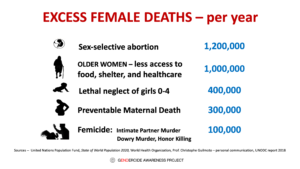
Feminicide is the killing of women for cultural reasons where there is no equivalent reason for killing men. Feminicide includes intimate partner murder, dowry murder, honor killing, and the killing of women associated with rival groups (gangs, tribes) as a strike against the group’s men. The total loss of female life due to feminicide is just under 100,000 per year.12c The asymmetry of feminicide leads advocates to define it, somewhat confusingly, as “killing a woman because she is a woman.” While women do occasionally kill their male partners, they generally do not do so as the culmination of behaviors intended to intimidate and control.
Different forms of gendercide occur in different parts of the world. 16
Sex-selective abortion is common in East, Southeast, and South Asia, the Caucasus, and Southeast Europe.
Women over age 50, especially widows, perish in Sub-Saharan Africa.
Excess female child mortality is highest in South Asia.
Maternal mortality is highest in Sub-Saharan Africa, Afghanistan, and Pakistan.
Femicide is universal and is the form of gendercide seen in Latin America, North America. and Europe.
- East Asia – China, Vietnam, Hong Kong, and Taiwan
- South Asia – India, Bangladesh, Nepal, Pakistan, and Afghanistan
- West Asia – Azerbaijan, Armenia, Georgia, Jordan
- Central Asia – Iran
- Southeast Europe – Albania, Montenegro, Kosovo
- North Africa – Egypt, Tunisia
- Sub-Saharan Africa – most countries
The number of women missing in a country can be measured in two ways – as either absolute numbers or as a percentage of the female population. In absolute terms, the world’s two most populous countries have the greatest number of missing women – 72 million missing in China and 46 million missing in India, as of 2020.17
When we look at percentages, it is evident that China, with 10.3 percent of its women missing, has eliminated a higher percentage of females than any other country in the world. India follows, with 6.8 percent missing.18.
These numbers reflect historical practices over many decades as well as current practices. To discern current practices, demographers look at a country’s sex ratio at birth (SRB), which shows sex-selective practices for the most recent year. The SRB is measured as #male births/100 female births. A normal SRB is 105-106 male births per 100 female births. This 5-6% excess in male births is completely normal and natural, as nature gives us more boys than girls at birth. (This is probably an evolutionary adaptation that compensates for the fact that little boys were more likely to die from childhood diseases than little girls — before the advent of modern medicine.) An SRB higher than 106 is considered abnormal and indicates that sex-selective abortion is occurring.
A comparison of 2020 SRBs in the most gendercide-affected countries reveals that sex-selective abortion of females is highest in Azerbaijan (SRB 114). China follows (SRB 111.9), then India (111.6), and Vietnam (111.5).19
These SRBs indicate that China’s SRB has dropped relative to a peak value of 121.2 in 2004, but it is still a long way from normal. The same is true for India.
In traditional societies, where social security and old-age pensions are non-existent, parents look to their sons to support them in old age. Daughters generally leave their parents to live with their husbands’ families. The result of this “patrilocal” tradition is that daughters do not care for their own parents, but rather their husbands’ parents. China’s former “one child” policy intensified the desire for that one child to be a son. The “one child” policy became a “two child” policy in 2015, and then a “three child” policy in 2021. These policy relaxations were implemented to expand the number of workers supporting China’s burgeoning population of retirees, but they carried the secondary benefit of slightly mitigating sex imbalance. Still, son preference remains strong in China, and the current sex ratio at birth deviates significantly from the natural sex ratio — more than any country except Azerbaijan.
A second reason for son preference lies in the prohibitive cost of marrying a daughter. In South Asia, where the dowry is common, the cost of a dowry and a wedding can add up to two years of family income. Often, the dowry is not a one-time gift but a stream of gifts paid to the groom’s family over the lifetime of the marriage. In regions where the dowry is practiced, 60% of families take out loans to pay for wedding expenses, often borrowing from unscrupulous loan sharks.20 In this context, the birth of a daughter is an economic catastrophe.
One might think that when men compete for a limited number of women, women’s power and prestige increases. However, sex imbalance often has the opposite effect. Frequently, it reduces the status of women and girls, as counter-intuitive as that might seem.
For Women: Sex trafficking is the flip side of the gendercide coin. Simply put, there are not enough women for all the men, so men seek out prostitutes. In Asia, girls are kidnapped, lured or sold into prostitution, with local governments making little effort to stop it. Often, local police protect the sex traffickers and frequent the brothels themselves. In addition, an unsavory black market in “brides” develops, with poor women sold to buyers in an arrangement indistinguishable from slavery. Often, brides are imported from other countries, creating a subclass of vulnerable non-citizens with no rights and no access to law enforcement or the justice system. Often, these women are beaten, abused, and resold to other men. In certain cases, a poor family may buy a girl to serve as a “bride” (sex slave) to all the men in the household. The world becomes a dangerous place for women, with abduction an ever present risk.17
For Girls: Because women are scarce, bachelors turn to ever younger girls as brides. Young girls are married off to much older men, sometimes even before the girls reach puberty. Once married, these girls have no time for education or paid work. Their older husbands and in-laws, eager for heirs, press them into childbearing as soon as possible. These girls give birth before their bodies are ready, resulting in high rates of maternal death and injury.18
For Bachelors: A surplus population of young men, mainly lower class, develops. These involuntary bachelors never marry, have families, or become part of society. The Chinese call them “bare branches” or “floaters.” In China, these men suffer from higher rates of depression, loneliness, alcoholism, and suicide. While the life expectancy for Chinese men is 75 years, for involuntary bachelors it is just 68 years.19
As of 2020 China has 34 million involuntary bachelors, 24 and India has roughly the same number.24a
Professors Valerie Hudson and Andrea den Boer have found that historically, when large-scale female infanticide occurred in Asia, surplus men formed an underclass of drifting, low paid workers with strong proclivities for violence and crime. When work was unavailable, they plundered the land. Predictably, the “bare branches” spent heavily on drinking, gambling, and prostitution. In both China and India, these historic patterns have re-emerged. Outbreaks of crime, violence, and vice, traceable to unassimilated young men, have erupted in regions where sex ratios are most skewed.20 Overall, crime in China doubled during the twenty-year span from 1995 to 2015, though not all of this can be attributed to the distorted sex ratio. A study by China’s Institute for the Study of Labor found that a 1% increase in the sex ratio causes a 5% increase in crime.21 In India, research has shown a striking correlation between sex ratios and murder rates across the states of India. A distorted sex ratio predicts murder rates better than poverty, illiteracy, or urbanization. 21a. Lastly, regional sex imbalance is associated with increases in rape, domestic violence, and use of guns.19
For Society: Social turmoil is a threat in societies with surplus males. It takes nothing more than an economic contraction to ignite the kindling. Historically in China and India, when famine struck regions with surplus males, the young men organized and rebelled, throwing off their overlords and seizing their lands. In China, such uprisings led to both the creation and overthrow of the Ming dynasty.22
Research also suggests that such societies can be governed only by authoritarian regimes.23 If true, prospects for democracy in Asia look dim.
In short, a healthy sex ratio stabilizes a society and makes it a more desirable place to live. There is a very direct correlation between the prosperity of a society and the rights enjoyed by its women.23a
Yes, the United Nations (UN) monitors missing women and sex ratios at birth through its Population Fund (UNFPA) and its Development Program, issuing reports on a regular basis. The UNFPA works with gendercide-affected countries to change attitudes about women and help regulate the technology involved in fetal sex selection. The UN does a good job of monitoring the problem and can claim some credit for changing behavior.
Sex ratios at birth have improved modestly in China and India (reported above), indicating that sex-selective abortion of females is somewhat less common than before.
In addition, maternal death rates dropped by 40% from 2000 – 2023,33 Most of that improvement occurred between 2000 – 2015. Progress since 2016 has been tepid.34
In 2008 the Indian Prime Minister Manmohan Singh became the first Indian leader to speak about the issue, calling it a “national shame.” A few doctors were prosecuted for sex determination. Billboards went up to persuade parents to keep their daughters, and in certain states, parents who gave birth to daughters received small securities that they could cash when their daughters reached eighteen.35
When Prime Minister Narendra Modi came to power in 2014, he addressed the problem of gendercide in his inaugural address, calling it a “form of mental illness” and pleading for young parents to keep their daughters. In 2015 he announced an initiative called Beti Bachao, Beti Padhao — Save a Girl, Educate a Girl — and released funds to a select group of Indian states with particularly distorted sex ratios, distributing them via the Ministry of Education, the Ministry of Women and Children, and the Ministry of Health.
In 2019 The Times of India published a scathing review of Beti Bachao, Beti Padhao, faulting the program for spending 43% of funds on media campaigns, while spending just 5% on girls’ education and 5% on girls’ health. Financial accountability was lax, with funds almost certainly lost to graft. In addition, the program did not hire local women for jobs where a local woman was needed for credibility and persuasive power. Lastly, Beti Bachao, Beti Padhao did not evaluate its own effectiveness.36
It is hard to know if the program worked. Some states saw improvements in the sex ratio at birth, while others saw deterioration.25b The country-wide average remains abnormally high, stuck at more than 111 male births per 100 female births.26
Chinese officials, too, have spoken of the problem and experimented with billboard campaigns and monetary rewards for parents of girls, usually at the local or provincial level. In 2006, a program of monetary rewards, called Care for Girls, was implemented on a nationwide scale. It gave $31 to parents who kept their daughters. This program and other initiatives helped China reduce its sex ratio at birth (SRB) from an all-time high of 121 male births per 100 female births in 2004, 29 down to 116 male births for every 100 female births in 2014.28
In 2015, China’s one-child policy became a two-child policy, and in 2021, it became a three-child policy. These changes were made, not to correct the sex ratio, but to encourage more births so that there would be enough future workers to support China’s large elderly population. The new policies have secondarily helped reduce the sex ratio. Nevertheless, China’s SRB remains highly elevated at 111 and is exceeded only by Azerbaijan at 114.29a A normal sex ratio at birth for China would be 105 or 106 male births per 100 female births. (Nature gives us more males than females at birth; historically, these numbers evened out by age 21 due to male infants’ greater susceptibility to childhood illness and male adolescents’ risk-taking behavior.)30
This is a legitimate question. First, think about the sheer size of the atrocity. The number of victims claimed by gendercide exceeds the number of deaths in World War I and World War II combined. Gendercide is the largest atrocity the world has seen, rivaled only by the genocide of indigenous people in the Americas — a loss of life estimated between 55 – 100 million people.

Second, consider that when earthquakes, floods, or famines occur around the world, we generally rush to help. But the ongoing decimation of women doesn’t make sensational headlines, so we tend to ignore it. Gendercide is an atrocity much like slavery in the American South; at the time many believed slavery was wrong yet also believed nothing could be done about it. It was a small number of visionaries who convinced others that slavery could be eliminated. We do not need to go to war to stop gendercide. We can address it peacefully. But let’s not find ourselves on the wrong side of history by failing to act.
Third, we care because we do have the power to help some, if not all, women. A little education or a micro-loan can work wonders for a woman, enabling her to grab a tiny slice of the economic pie. Women who make money become more valued in their communities, and unlike many men, they use nearly all their earnings to provide for the health and well-being of their children.
Yes, the example of South Korea stands as a beacon of hope. In 1985, with sex-selective technology easily accessible, the sex ratio at birth (SRB) in South Korea had shifted dramatically in favor of boys, with 115 boys born for every 100 girls. Technology provided new means to ancient ends. At the same time, however, South Korea began educating girls, passing equal opportunity legislation, revising its patriarchal family laws, and punishing doctors for doing pre-natal sex determination tests. Attitudes changed, and in 2007, South Korea registered a perfectly normal SRB of 106 boys for every 100 girls.31 (In developed countries, a normal SRB ranges from 105 to 107.)32 Although South Korea is still missing women due to its past practices,33 it points the way for other economically advanced countries, such as Taiwan.
In low-income countries, a bottom-up approach may prove more effective. Although most countries have banned infanticide and sex-selective abortion, the laws are largely ignored. Enforcement is difficult, and there is little will to do it. Change cannot be mandated from the top; it must arise from below as communities slowly begin to value their women.
For this reason, programs that train, educate, and provide micro-financing for women seem to be the most effective antidote to the gendercide crisis. In their book Half the Sky: Turning Oppression into Opportunity for Women Worldwide, the husband-wife journalist team of Nicholas Kristof and Sheryl WuDunn catalog stories of Asian and African women, sometimes themselves oppressed, who overcame tremendous odds to improve the lives of other women by establishing shelters, schools, hospitals, and small businesses. Kristof and WuDunn call these women “social entrepreneurs.” Once these indigenous programs took root, western donors often provided crucial cash to expand them.
The authors also relate stories of poor, brutalized women (often women sold into prostitution), who escaped or defied their oppressors and rebuilt their lives. Well run aid programs, both indigenous and western, catalyzed these turnarounds by offering help at critical moments. These women learned new trades and earned money, garnering hard-earned respect and becoming engines of change for other women in their communities.
As a result of their experience, Kristof and WuDunn came to believe that with small amounts of assistance, women can engineer their own bottom-up emancipation. To do this, they need three things. First, they need assistance with schooling. Not only does education prepare girls for better jobs, but also it delays marriage and prevents girls from being trafficked.33a Second, women overseas need micro-finance – tiny loans of cash or materials (such as seeds, or goats) that they use to launch small businesses and then repay. When women contribute to a family’s income, they win greater autonomy and decision-making power at home, and sometimes, the grudging respect of their husbands. Finally, these women need help with reproductive and maternal healthcare. They must be able to avoid AIDS, space and limit their children, and deliver safely.
With such progress occurring at the grassroots level, top-down government measures are more likely to succeed. Scholars and journalists in both China and India have sounded the alarm regarding the destabilizing effects of sex ratios in their countries. Both governments have tried to promote new attitudes toward women, but with little effect.34
Yet certain women in the developing world have shown how plucky and determined they can be. In the face of beatings, rape, imprisonment, and death, these women have reached to help others. If we extend their reach by giving wisely for girls’ education, micro-finance, and healthcare, we can accelerate the pace of change.
- United Nations Population Fund, UNFPA State of the World Population 2020, p.51.
- United Nations Population Fund, UNFPA State of the World Population 2020, p.53.
- Valarie M. Hudson and Andrea M. den Boer, Bare Branches: The Security Implications of Asia’s Surplus Male Population; Cambridge, MA, The MIT Press, 2005, pp. 109-113, 171-172. See also, Mara Hvistendahl, Unnatural Selection: Choosing Boys over Girls, and the Consequences of a World Full of Men; Philadelphia, PA., Public Affairs (in the Perseus Books Group), 2011.
- Bare Branches, pp. 112-113, 157.
- Bare Branches, pp. 114-119.
- Christophe Z. Guilmoto, Senior Fellow in Demography, Institut de Recherche pour le Developpement, Université Paris Descartes, personal communication. These data, though not published, were collected with John Bongaarts when researching 12a below.
- World Health Organization, 2020.
- Nicholas D. Kristof and Sheryl WuDunn, Half the Sky: Turning Oppression into Opportunity for Women Worldwide; Vintage Books, 2010, pp. 109-122.
- Bare Branches, p. 122. See also, Rita Banerji, items 9-10. In India the number of dowry murders (bride burnings) is estimated at 8,000 per year, and in Pakistan, at about 2,000 per year. See Rebecca Bundhun, Dowries and Death Continue Apace in India, The National, February 10, 2017, and Tehseen Saeed, Dowry Murder, The Tribune, March 2017. Bangladesh registered 4,500 dowry murders per year prior to 2014. See UN Women Report 2014 – Annexes United Nations (May 2014), Table 6 page xiii.
- Juan Forero, Women in Latin America are Being Murdered at Record Rates, The Wall Street Journal, Dec. 19, 2018 and Reuters News, First Drugs, then oil, now Mexican cartels turn to human trafficking, April 29, 2020.
- Graham Lee Brewer, The Crisis of Missing and Murdered Indigenous Women, High Country News, May 4 2018 and Carrie N. Baker and Katie Fleischer, Legislation to Address Missing and Murdered Indigenous Women Signed into Law, Oct. 12, 2020.
- Amartya Sen, “More Than 100 Million Women are Missing,” The New York Review of Books, December 20, 1990.
- United Nations Population Fund, UNFPA State of the World Population 2020, p. 49.
- John Bongaarts and Christophe Z. Guilmoto, “How Many More Missing Women? Excess Female Mortality and Prenatal Sex Selection, 1970–2050,” Population and Development Review 41(2): 241–269 (JUNE 2015), see chart p. 247, p. 258 (behind a paywall, unfortunately).
- John Bongaarts and Christophe Z. Guilmoto, “How Many More Missing Women? Excess Female Mortality and Prenatal Sex Selection, 1970–2050,” Population and Development Review 41(2): 241–269 (JUNE 2015), see chart p. 247, p. 258. Also, Christophe Z. Guilmoto, Senior Fellow in Demography, Institut de Recherche pour le Developpement, Université Paris Descartes, personal communication. These data, though not published in this format, were collected with John Bongaarts when researching “How Many More Missing Women?” Data for maternal deaths came from World Health Organization, 2015. For global femicide numbers, see UNWomen Press Release, 2025 and the United Nations Office of Drugs and Crime, Femicides in 2024: Global estimates of intimate partner/family member femicides.
- United Nations Population Fund, UNFPA State of the World Population 2020, pp. 48-54.
- United Nations Population Fund, UNFPA State of the World Population 2020, p. 53.
- Percentages were calculated by dividing the number of missing females for these countries (as of 2020) by the female populations of those countries (as of 2020).
- United Nations Population Fund, UNFPA State of the World Population 2020, p. 48.
- Rajineesh Kumar Yadav, Debt-free weddings prevent slavery in India, The Huffiington Post, Dec. 6, 2017.
- Half the Sky, pp. xi-60 and Bare Branches, pp. 202-206, 214, 237, 241-243. Few studies have been done to document the link between sex trafficking and sex imbalance. Anti-trafficking activists report this link, and the annual US State Department Trafficking in Persons reports allege such a link, but data are thin. A study in India finds that for every (roughly) 1% increase in the sex ratio, there is a 0.635 increase in number of women trafficked. See Nishith Prakash and Krishna Chaitanya Vadlamannati, “Girls for Sale? Child Sex Ratio and Girls Trafficking in India,” IZA Discussion Paper No. 8293, June 2014. (IZA – Forschungsinstitut zur Zukunft der Arbeit, Institute for the Study of Labor, Germany. However, another study cautions that regions of the world with normal sex ratios (Latin America, Eastern Europe) have substantial trafficking problems, too, suggesting that multiple causes are in play. See Therese Hesketh and Zhu Wei Xing, “Abnormal sex ratios in human populations: Causes and consequences,” PNAS, Vol. 103 No. 36, pp. 13271–13275, Sept. 5, 2006. More studies need to be done on this subject.
- Regarding the correlation between distorted sex ratios and child marriage, see Bare Branches, pp. 204-205 and Unnatural Selection, pp. 190-191. Researchers also report a correlation between distorted sex ratios and spousal age gap (the difference in age between husband and wife). See Reshmaan Hussam, “Marry Rich, Poor Girl: Investigating the Effects of Sex Selection on Intrahousehold Outcomes in India,” in Harvard Business School, Working Knowledge: Business Research for Business Leaders, 09 Oct 2017, Abstract, p. 22. Lena Edlund argues that sex selection expands the wealth gap between men and women in areas where it is practiced, privileging men over women. See “Son Preference, Sex Ratios, and Marriage Patterns,” Journal of Political Economy, 1999, vol. 107, no. 6, pt. 1, Abstract, p. 295.
- The World Health Organization reports that maternal death rates for teen mothers under age 16 are four times higher than for women in their early 20’s. Maternal death is the leading cause of death worldwide for girls aged 15-19. “Pregnancy and childbirth complications are the leading causes of death among 15-19 year old girls,” World Health Organization, 2025.
- Avraham Y. Ebenstein and Ethan Jennings Sharygin, “The Consequences of the “Missing Girls” of China,” The World Bank Economic Review, VOL. 23, No. 3, pp. 399-425, 2009, and Professor Li Shuzhuo, Director of the Institute for Population and Development Studies, Xi’an Jiaotong University, verbal communication, 2015. Lastly, Nadia Diamond-Smith and Kara Rudolph find an increase in sex crimes, domestic violence, and use of guns in regions with highly distorted sex ratios. “The association between uneven sex ratios and violence: Evidence from six Asian countries,” PLOS One (Public Library of Science), 2018.
- Anna Fifield, “Two-husband strategy may be a solution for China’s one-child policy, professor posits,” The Washington Post, June 10, 2020.
- Kunal Anand, “The real truth behind the crores of forced bachelors in India,” The India Times, June 14, 2017.
- Bare Branches, pp. 203, 234-241, and Unnatural Selection, pp. 221-223.
- Elizabeth Winkler, “China’s One-Child Policy May Be Making the Country More Violent: A 1 percent increase in the ratio between the sexes leads to a 5 percent increase in the Crime Rate,” New Republic, June 27, 2014. See also Lena Edlund, Hongbin Li, Junjian Yi, Junsen Zhang, “Sex Ratios and Crime: Evidence from China’s One-Child Policy,” in Review of Economics and Statistics, 2013, 95(5), 1520-1534. The latter study estimates that the sex ratio accounts for one seventh of the increase in crime in China.
- Jean Dreze and Reetika Khera, “Crime, Gender, and Society in India: Insights from Homicide Data,” Population and Development Review, Vol. 26, No. 2 (June 2000), p. 342. Cited in Bare Branches, pp. 240-241.
- Bare Branches, pp. 207-227.
- Bare Branches, p. 259. Hudson and den Boer cite Christian G. Mesquida and Neil I. Wiener, “Human Collective Aggression: A Behavior Ecology Perspective,” Ethology and Sociobiology, Vol. 17, No. 4 (July 1996), pp. 247-262, and Laura Betzig, “Despotism and Differential Reproduction: A Cross-Cultural Correlation of Conflict Asymmetry, Hierarchy, and Degree of Polygyny,” Ethology and Sociobiology, Vol. 3, No. 4 (1982), pp. 209-221.
- Valerie M. Hudson, Bonnie Ballif-Spanvill, Mary Caprioli, and Chad F. Emmett, Sex and World Peace, Columbia University Press, 2014. The correlation between women’s rights and a country’s prosperity is a central tenet of the book.
25 Unnatural Selection, pp. 225-229.
25a Mitali Nikore, Beti Bachao, Beti Padhao: A Critical Review of Implementation, The Times of India, Jan. 3, 2019.
25b Aparna Kalra, “Modi’s (Shaky) Race to Save India’s Girls,” May 23, 2015 and “An Evaluation of Prime Minister Modi’s ‘Beti Padhao, Beti Bachao’ Initiative,” Centre for Development and Human Rights, February 19, 2016.
26 United Nations Population Fund, UNFPA, State of the World Population 2020, p. 46.
28 Yuen Yeuk-laam “China census shows continuing gender imbalance, aging population,” Global Times Published, 21-1-2015
29 Christina Larson, “In China More Girls Are on the Way,” Bloomberg Business, July 31, 2014.
29a United Nations Population Fund, UNFPA State of the World Population 2020, p. 46. Download the full report; the information is not available in the summary on the website.
30 Klasen and Wink, Missing Women: A Review of the Debates and an Analysis of Recent Trends, 2002., pp. 2-3, pp. 14-15.
31 Christophe Guilmoto, “Sex Ratio Transition in Asia,” Population and Development Review 35(3): 519-549 (September 2009), pp. 524, 536.
32 Klasen and Wink, pp. 14-15. In developing countries plagued with malnutrition, a normal SRB is lower – closer to 104. Maternal malnutrition results in a disproportionately large number of male fetuses being either miscarried or stillborn, thus lowering the sex ratio at birth.
33 United Nations Development Program, see the Asia-Pacific Human Development Report called Power, Voice, and Rights: A Turning Point for Gender Equality in Asia and the Pacific, 2010, p. 42.
33a World Bank, Development Report on Gender Equality and Development, 2012.
34 Bare Branches, pp 249-254 and Unnatural Selection, pp. 225-229.